

San Antonio Water Softeners & Filtration Guide
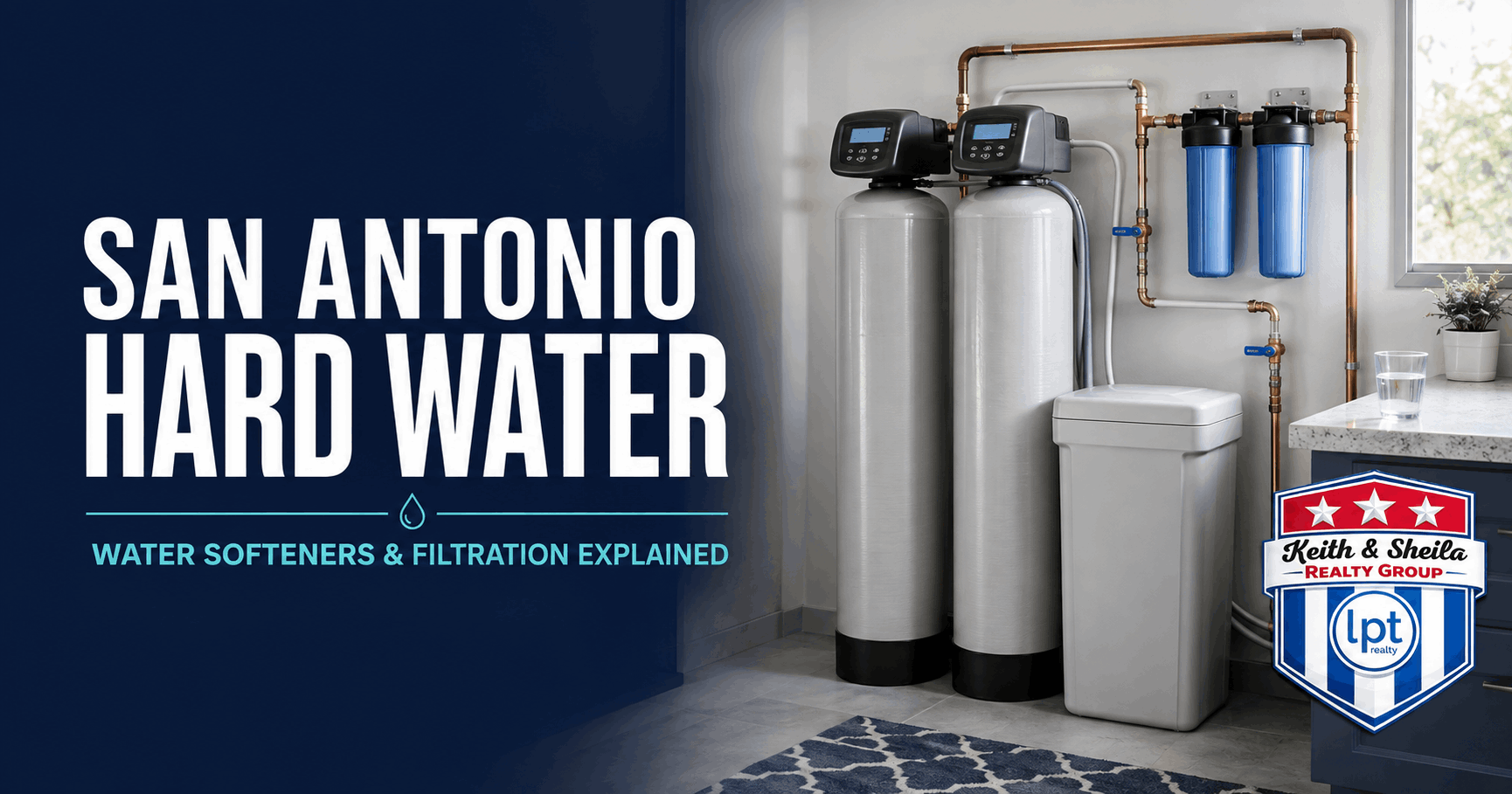
Water Filtration & Water Softener Systems for Greater San Antonio Hard Water
White scale on faucets, cloudy glassware, soap that will not lather well, and mineral buildup around fixtures are familiar problems in our area. The right treatment starts with understanding that a water softener, a filter, a salt-free conditioner, and reverse osmosis do different jobs.
How Hard Is San Antonio Water?
San Antonio Water System reports that the water it provides is typically 15–20 grains per gallon. That equals roughly 257–342 milligrams per liter as calcium carbonate. The U.S. Geological Survey classifies water above 180 milligrams per liter as very hard, so the typical SAWS range falls well into the very-hard-water category.
Typical SAWS hardness: Hardness mainly reflects dissolved calcium and magnesium. It is usually an aesthetic and maintenance concern—not, by itself, evidence that municipal water is unsafe to drink.
SAWS uses water from several sources, including the Edwards, Carrizo, Trinity, and Wilcox aquifers. The exact hardness at a particular home can vary with source blending, location, season, and utility. Homes in Cibolo, Schertz, New Braunfels, Boerne, Bulverde, Helotes, and other surrounding communities may be served by different utilities or private wells, so a local water report or test is more useful than relying on a regional average.
Start with the water—not the equipment: Review your utility’s current Consumer Confidence Report and test private-well water through an appropriate laboratory. Choose equipment based on the hardness level or specific contaminant you want to reduce.
What Hard Water Can Do to a Home
Calcium and magnesium can leave scale as water is heated or evaporates. That scale can accumulate on shower glass, faucet aerators, valves, heating elements, and plumbing fixtures. It can also make cleaning products work less efficiently and leave residue on dishes or surfaces.
Scale and spotting
White crust around faucets, spots on glassware, film on shower doors, and deposits in coffee makers are common clues.
Reduced efficiency
Scale can collect on water-heater components and inside water-using appliances, potentially reducing efficiency and useful life.
Restricted flow
Aerators, showerheads, cartridges, and small passages can lose flow as deposits accumulate.
More soap and maintenance
Hard water can interfere with soap performance and increase the time spent removing deposits from kitchens and bathrooms.
Water Softener vs. Filter vs. Conditioner vs. Reverse Osmosis
One of the biggest purchasing mistakes is assuming every device labeled “water treatment” removes hardness and contaminants. Match the technology to the problem you actually have.
| System | Primary job | What it does not automatically do | Certification to look for |
|---|---|---|---|
| Ion-exchange water softener | Removes calcium and magnesium hardness by exchanging them for sodium or potassium ions. | Does not automatically remove every drinking-water contaminant, chlorine, or dissolved solids. | NSF/ANSI 44, including verified efficiency information when available. |
| Salt-free scale conditioner | May alter scale-forming behavior to reduce deposits in certain conditions. | Does not remove calcium and magnesium or produce truly softened water. | IAPMO/ANSI Z601 or another credible certification for the claimed scale reduction. |
| Activated-carbon filter | Can improve chlorine-related taste and odor; specific products may reduce additional substances. | Does not soften water unless paired with a separate softening technology. | NSF/ANSI 42 for aesthetic claims; NSF/ANSI 53 for certified health-effect claims. |
| Sediment filter | Captures particles such as sand, silt, or rust, depending on micron rating. | Does not remove dissolved hardness minerals or most dissolved contaminants. | Certification and performance appropriate to the housing, filter, flow rate, and particle claim. |
| Point-of-use reverse osmosis | Treats drinking and cooking water at one fixture using a semipermeable membrane; certified models may reduce specific dissolved contaminants. | Does not normally treat every fixture in the home and creates a reject-water stream. | NSF/ANSI 58 and certification for each specific reduction claim. |
Certification is claim-specific. A product carrying an NSF mark is not necessarily certified to remove everything. Check the standard number and the exact contaminant-reduction or performance claims in the certification listing.
Which System Combination Makes Sense?
Water softener
A properly sized ion-exchange softener is the most direct way to remove calcium and magnesium hardness throughout the home.
Certified carbon filtration
A point-of-use or whole-house carbon system may help, depending on the source of the taste or odor and the product’s certified claims.
Under-sink RO
A certified point-of-use RO system may reduce specific dissolved substances at the kitchen sink. It should be selected for documented needs and maintained on schedule.
Layered treatment
Some homes use a softener for hardness, carbon for taste or odor, and an under-sink RO unit for drinking and cooking water. Each component should have a defined purpose.
Private wells require a different approach. Test for bacteria and locally relevant contaminants before selecting treatment. Sediment, iron, manganese, sulfur odors, hardness, and microbiological concerns may require different technologies and a professionally designed sequence.
How to Choose a Water Softener for San Antonio Hard Water
A softener should be sized using measured hardness, household water use, peak flow demand, and the system’s usable grain capacity—not simply the square footage of the house. Oversizing and poor programming can waste salt and water; undersizing can cause hardness breakthrough or overly frequent regeneration.
Look for demand-initiated regeneration
Demand-initiated systems regenerate based on measured water use or remaining capacity instead of regenerating automatically on a fixed calendar. EPA guidance identifies demand-initiated regeneration as the more efficient approach.
Compare water and salt efficiency
EPA’s 2026 selection guidance recommends looking for units that use no more than 5 gallons of regeneration water per 1,000 grains of hardness removed and achieve more than 3,350 grains of hardness exchange per pound of salt. Efficient settings matter because regeneration consumes water and sends sodium and chloride to the wastewater system.
Keep unnecessary fixtures off softened water
Exterior hose bibs and irrigation systems generally do not need softened water. Bypassing them can reduce salt, regeneration water, and operating costs. Depending on household preference and professional guidance, a separate unsoftened cold-water tap may also be retained for drinking or cooking.
Verify plumbing and drain requirements
Confirm available space, electrical service, drain routing, air-gap requirements, water pressure, pipe size, shutoff access, and local plumbing-code requirements before installation. The system must also provide enough flow for simultaneous showers and fixtures without creating a noticeable pressure drop.
What to Know About Reverse Osmosis
A point-of-use RO unit can be useful when its certified reduction claims match a documented drinking-water concern or household preference. It is not automatically necessary for every municipal-water home, and it should not be sold as a substitute for understanding the local water-quality report.
Traditional RO systems create reject water while producing treated water. EPA notes that older or inefficient point-of-use systems can waste five gallons or more for each gallon of treated water. When purchasing an RO system, compare efficiency ratings, storage-tank recovery, membrane production, replacement-filter costs, and the availability of service parts. Look for a WaterSense-labeled model when eligible products are available and verify NSF/ANSI 58 certification for the claims you need.
Maintenance Matters as Much as the Equipment
- Test hardness before installation and confirm the softener is programmed for the actual number.
- Keep the brine tank supplied with the salt recommended by the manufacturer.
- Inspect for salt bridging, leaks, continuous drain flow, or unexpected regeneration.
- Replace sediment, carbon, and RO filters on schedule—or sooner if pressure drop or water quality indicates a problem.
- Sanitize and service equipment according to manufacturer instructions.
- Retest treated water periodically to confirm the system still performs as intended.
- Keep model numbers, manuals, warranties, installer information, and service records for future owners.
A filter left beyond its rated service life may stop performing as claimed. Replacement frequency depends on water use, incoming water quality, filter capacity, and manufacturer instructions—not just the calendar.
Buying a San Antonio Home With an Existing System
During the option period, identify whether the equipment is owned, leased, financed, or tied to a service contract. A water-treatment unit can look impressive while being bypassed, improperly sized, exhausted, or in need of expensive replacement media.
- Ask for the original invoice, model and serial numbers, warranty, manuals, and service history.
- Confirm whether the equipment conveys with the home and whether any balance or contract remains.
- Check for leaks, corrosion, damaged bypass valves, improper drain connections, and pressure loss.
- Test untreated and treated hardness rather than judging by appearance alone.
- Determine which fixtures receive softened or filtered water.
- Budget for salt, replacement filters, membranes, service, and eventual equipment replacement.
As a former Texas Professional Inspector with approximately 4,000 inspections and a former licensed irrigator, Keith has seen how water quality, plumbing design, drainage, and deferred maintenance can affect a home. A general home inspection can identify visible conditions, but water testing and treatment performance should be handled by appropriately qualified professionals.
Frequently Asked Questions
How hard is the water in San Antonio?
SAWS reports typical hardness of 15–20 grains per gallon, roughly 257–342 milligrams per liter as calcium carbonate. Under U.S. Geological Survey guidelines, that is considered very hard water. Other Greater San Antonio utilities and private wells may differ.
Is San Antonio hard water unsafe to drink?
Hardness mainly reflects dissolved calcium and magnesium and is generally an aesthetic and maintenance issue rather than, by itself, a health-based drinking-water violation. Review your utility’s current water-quality report or test private-well water for specific concerns.
Does a whole-house water filter soften water?
Not unless the system includes a true softening technology. Carbon and sediment filters can treat certain tastes, odors, or particles, but they do not normally remove dissolved calcium and magnesium hardness.
What is the difference between a water softener and a salt-free conditioner?
An ion-exchange softener removes calcium and magnesium hardness. A salt-free conditioner may reduce scale formation under certain conditions, but it generally leaves the hardness minerals in the water and does not produce truly softened water.
Do I need reverse osmosis if I already have a water softener?
They perform different jobs. A softener removes hardness minerals throughout the home. A point-of-use reverse-osmosis system treats drinking water at a specific fixture and may reduce contaminants identified in its certification. Whether both are appropriate depends on test results, water-quality goals, and household preferences.
Should outdoor faucets and irrigation use softened water?
Usually not. Exterior hose bibs and irrigation generally do not require softened water. Bypassing these uses can reduce salt consumption, regeneration frequency, wastewater, and operating costs.
What certification should I look for when buying water-treatment equipment?
Match the certification to the claim: NSF/ANSI 44 for residential ion-exchange softeners, NSF/ANSI 42 for aesthetic filtration claims, NSF/ANSI 53 for certain health-effect reduction claims, and NSF/ANSI 58 for reverse-osmosis systems. Verify the exact certified claim and model in an independent listing.
How should a San Antonio water softener be sized?
Sizing should use measured hardness, household water consumption, peak flow demand, and usable grain capacity. Square footage alone is not enough. A properly sized demand-initiated system can reduce unnecessary salt and regeneration water.
Buying or Selling a Greater San Antonio Home?
Keith & Sheila Realty Group combines 14 years as a professional spouse team with hands-on experience in real estate, inspections, construction, and irrigation. We help clients look beyond finishes and understand the systems that affect everyday homeownership.
This article provides general educational information and is not plumbing, engineering, medical, environmental, or water-quality advice. Water chemistry, plumbing, private-well conditions, treatment needs, codes, and equipment performance vary. Consult your water utility, an appropriately qualified laboratory, licensed plumber, water-treatment professional, or other appropriate specialist before selecting or installing equipment. Information is current as of August 2026.
Official references: SAWS Water Quality FAQs, 2026 SAWS Water Quality Report, USGS Water Hardness Guidance, EPA Water Softener Selection Guide, EPA Point-of-Use Reverse Osmosis Guidance, and NSF Water Treatment Standards.
Categories
Recent Posts










"Words cannot express our gratitude and thankfulness that Keith provided us when buying our home. Being a military family and not being able to physically be there is beyond challenging buying a house unseen. He made this whole process so pleasant and easy, always easing our minds because he had our complete best interests in his hands. He took the time to send videos, pictures, and did several walk-through of the home to make us feel like we were there. You can easily tell Keith has years of experience , always answering questions and helping us every step of the way! He was extremely helpful in guiding us through the process of buying our home, and making sure that everything was taken care of promptly and correctly. He has been nothing but extremely responsive and excellent since the first phone call! Keith is incredibly knowledgeable, a go-getter, and super professional. We truly sat in passenger seat and let Keith do the driving. He went above and beyond to find the perfect home for us. There's not another realtor out there that could've provided us with the ease and comfort knowing we were making all the right decisions! Keith and Sheila have our highest recommendation, and we wouldn’t ever want to work with any other agent. We will refer our friends and family to Keith and Sheila Realty again and again!" Nicole Olson - 2024