

Water Softener vs. Water Filter: Why You Need Both
HOMEOWNER RESOURCE | SAN ANTONIO & CENTRAL TEXAS
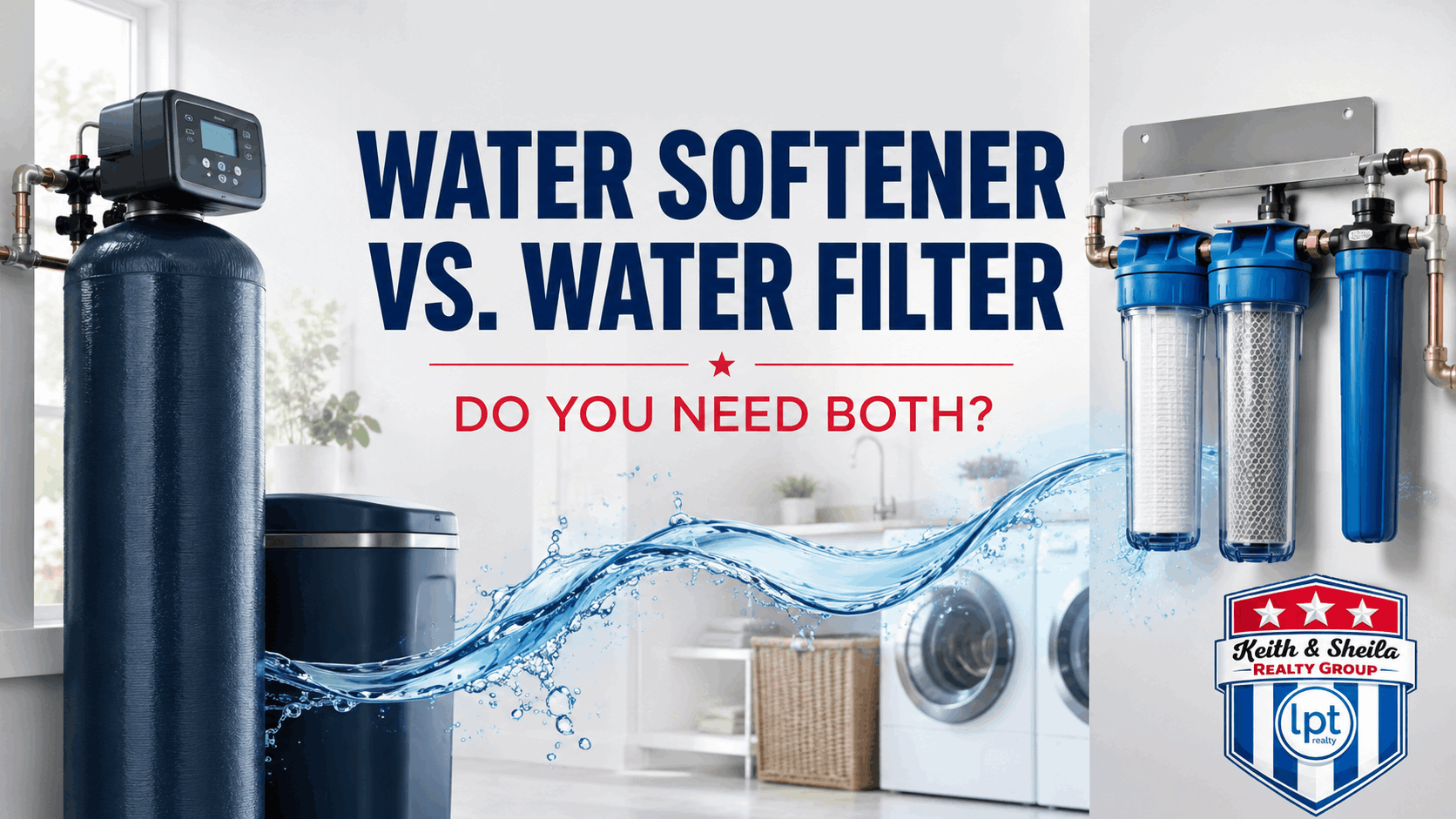
Water Softener vs. Water Filter: What Is the Difference, and Do You Need Both?
Many homeowners use the terms water softener and water filter as though they describe the same thing. They do not. A softener primarily treats the minerals that cause hard water, while a filter is designed to reduce particular substances based on the filter media, technology, and certification.
In a hard-water area such as Greater San Antonio, the most complete solution may include both systems—but only after you understand your water and decide what you want to improve.
Why Water Treatment Matters in the San Antonio Area
Much of the San Antonio area receives naturally mineral-rich water. San Antonio Water System reports that its typical water hardness ranges from approximately 15 to 20 grains per gallon. That is considered very hard water and can contribute to mineral deposits on faucets and shower glass, reduced soap lather, and scale inside water-using appliances.
Hard water is generally an aesthetic and maintenance concern—not automatically a health hazard. A home may have safe municipal drinking water and still experience heavy scale. Likewise, water can be softened without being filtered for the taste, odor, or particular contaminants that concern the homeowner.
What Is a Water Softener?
A traditional salt-based water softener is designed to reduce hardness minerals, primarily calcium and magnesium. Most residential softeners accomplish this through a process called cation ion exchange.
Inside the softener tank is a bed of resin beads. As hard water passes through the tank, calcium and magnesium ions attach to the resin and are exchanged for sodium or potassium ions. Over time, the resin reaches capacity and must be regenerated with a brine solution so it can continue treating the water.
What a water softener can help with
- White mineral scale on faucets, fixtures, and shower glass
- Soap scum and difficulty getting soap or detergent to lather
- Mineral buildup inside water heaters, dishwashers, and washing machines
- Spotted dishes and glassware
- The extra cleaning and maintenance associated with very hard water
What a standard water softener does not necessarily do
A standard softener is not a universal purification system. It is not designed to reduce every chemical, microorganism, taste, odor, or dissolved solid. Some specialized ion-exchange systems carry additional reduction claims, but homeowners should never assume that a softener removes a substance unless the manufacturer specifically identifies and certifies that capability.
What Is a Water Filter?
A water filter is a broad category of treatment equipment designed to reduce particular substances in water. Its performance depends entirely on the treatment technology and the product's verified reduction claims. One filter may reduce chlorine taste and odor, while another may be certified to reduce lead. A reverse-osmosis system may reduce a wider range of dissolved substances, and a properly specified ultraviolet system may address microorganisms.
Common types of residential water filtration
- Whole-house sediment filters: Help capture sand, rust, silt, and other particles before water reaches fixtures and appliances.
- Activated-carbon filters: Commonly used to improve taste and odor and reduce chlorine; specific performance varies by model.
- Under-sink or countertop filters: Treat water at one location, usually the kitchen sink, for drinking and cooking.
- Reverse-osmosis systems: Use a semipermeable membrane and other filter stages to reduce many dissolved substances. Always check the exact certified claims.
- Ultraviolet treatment: Uses UV light for microbial treatment when the equipment is properly selected, installed, and maintained. UV does not remove hardness or sediment.
- Shower filters: Typically have limited treatment claims; an NSF/ANSI 177-certified shower filter is certified for reduction of free available chlorine.
Water Softener vs. Water Filter: A Simple Comparison
| Question | Water Softener | Water Filter |
|---|---|---|
| Primary purpose | Reduce calcium and magnesium hardness | Reduce specified particles, chemicals, tastes, odors, or other substances |
| Typical technology | Ion exchange | Sediment media, carbon, membranes, UV, or other technologies |
| Helps prevent scale | Yes, when properly sized and maintained | Usually no, unless specifically designed for scale control |
| Improves taste or odor | Not its primary purpose | Often, depending on the filter and its claims |
| Reduces lead or other health-related contaminants | Do not assume so | Only when certified for the specific substance |
Do You Really Need Both?
Many San Antonio-area households can benefit from both, because the two systems solve different problems:
- The softener treats hardness to reduce scale and improve the way water works with soap.
- The filter treats selected water-quality concerns such as sediment, chlorine taste and odor, or other substances named in the product's certified claims.
A common setup is a whole-house sediment or carbon filtration system paired with a water softener, plus an optional reverse-osmosis unit at the kitchen sink for drinking and cooking water. However, that is not a one-size-fits-all prescription. Your best configuration depends on the source water, plumbing, household size, flow-rate needs, and the specific conditions you want to treat.
Should the Filter or Softener Come First?
The correct order depends on the equipment and the water conditions. In many installations, a sediment prefilter is placed before the softener to help protect the resin and control valve from suspended particles. Certain whole-house carbon systems may also be installed before the softener, while other treatment devices may belong after it.
Do not rely on a generic diagram. Follow the manufacturers' requirements and have a qualified water-treatment professional size and arrange the equipment for the home's water pressure, peak flow rate, hardness level, plumbing, and treatment goals.
How to Choose the Right System
1. Start with your water source and report
If the home is served by a public utility, review its current Consumer Confidence Report. If the property uses a private well, laboratory testing is especially important because the well owner is responsible for monitoring and treating the water.
2. Test for the conditions you plan to treat
At minimum, confirm the hardness level before sizing a softener. If you are concerned about a particular substance, test for it through an appropriate laboratory rather than buying a system based only on a sales demonstration.
3. Look for independent certification
Read the product data sheet and verify the exact reduction claim. Useful standards include:
- NSF/ANSI 44: Residential cation-exchange water softeners
- NSF/ANSI 42: Aesthetic effects such as chlorine taste and odor
- NSF/ANSI 53: Reduction claims involving substances with health effects
- NSF/ANSI 58: Reverse-osmosis drinking-water treatment systems
- NSF/ANSI 55: Ultraviolet microbiological water-treatment systems
4. Size the equipment correctly
A softener should be sized using measured hardness, household water use, and peak flow—not simply the number printed on the box. An undersized system may regenerate too often or allow hard-water breakthrough, while an oversized or poorly programmed unit may waste salt and water.
5. Budget for ongoing maintenance
Softeners need salt or potassium replenishment and periodic inspection. Filters require scheduled cartridge or media replacement. Reverse-osmosis units require filter and membrane service, and UV systems require lamp replacement and monitoring. A system that is not maintained may stop performing as intended.
Important Homebuyer Questions
If a home already has water-treatment equipment, do not assume it is operational, owned free and clear, or appropriate for the water supply. Ask:
- Is the system owned, financed, or leased?
- Will any loan, lease, or service agreement transfer with the property?
- When was the equipment installed?
- What brand and model is it?
- What does the manufacturer say it is certified to reduce?
- When were the resin, media, cartridges, membrane, or UV lamp last serviced?
- Is there a bypass valve, drain connection, and accessible shutoff?
- Has the treated water been tested recently?
Water-treatment equipment should also be considered during the home inspection. The inspector may identify visible defects or installation concerns, but specialized water testing and treatment evaluation may require a qualified laboratory or water-treatment contractor.
The Bottom Line
A water softener and a water filter are not interchangeable. A softener is primarily intended to reduce hardness minerals. A filter is selected to reduce particular particles, chemicals, tastes, odors, or microorganisms according to its technology and certified claims.
For many Greater San Antonio homes, using both can provide the best overall result: softened water to protect fixtures and appliances, plus properly selected filtration for the household's taste, odor, sediment, or drinking-water goals. Start with reliable water information, choose certified equipment for the specific job, and make sure the system is sized, installed, and maintained correctly.
Buying or selling a home in Greater San Antonio?
Keith & Sheila Realty Group combines real estate experience with Keith's background as a former Texas Professional Inspector to help clients ask better questions about a home's systems and condition. Water-treatment decisions should be confirmed with the appropriate laboratory and qualified water-treatment professional.
Frequently Asked Questions
Does a water softener filter drinking water?
A standard ion-exchange softener primarily reduces calcium and magnesium hardness. It should not be treated as a universal drinking-water filter unless the equipment has verified certifications for additional reduction claims.
Does a water filter soften hard water?
Most sediment and carbon filters do not remove the dissolved calcium and magnesium that cause hardness. Some technologies offer scale control, but that is not necessarily the same as true ion-exchange softening.
Is San Antonio water considered hard?
Yes. SAWS reports typical hardness of approximately 15 to 20 grains per gallon, which falls in the very-hard range and can cause noticeable scale and spotting.
Can a water filter remove lead, bacteria, and chlorine?
No single generic filter should be assumed to remove all three. Choose equipment independently certified for each specific reduction claim. For example, certain filters are certified for lead reduction, carbon systems may reduce chlorine taste and odor, and properly specified UV systems may provide microbial treatment.
Is reverse osmosis the same as water softening?
No. Reverse osmosis is a membrane-based filtration process, usually used at a drinking-water tap. A whole-house softener uses ion exchange to treat hardness throughout the home.
How do I know which system my home needs?
Review your utility's water-quality report or obtain appropriate laboratory testing, identify the specific problems you want to address, and select equipment with certified performance claims for those conditions.
Sources: San Antonio Water System Water Quality FAQs; U.S. Geological Survey: Hardness of Water; U.S. EPA: Drinking Water Treatment Technologies; NSF Water Treatment Standards.
This article is for general educational purposes and is not a substitute for water testing, health advice, or a site-specific evaluation by a qualified professional.
Categories
Recent Posts









"Words cannot express our gratitude and thankfulness that Keith provided us when buying our home. Being a military family and not being able to physically be there is beyond challenging buying a house unseen. He made this whole process so pleasant and easy, always easing our minds because he had our complete best interests in his hands. He took the time to send videos, pictures, and did several walk-through of the home to make us feel like we were there. You can easily tell Keith has years of experience , always answering questions and helping us every step of the way! He was extremely helpful in guiding us through the process of buying our home, and making sure that everything was taken care of promptly and correctly. He has been nothing but extremely responsive and excellent since the first phone call! Keith is incredibly knowledgeable, a go-getter, and super professional. We truly sat in passenger seat and let Keith do the driving. He went above and beyond to find the perfect home for us. There's not another realtor out there that could've provided us with the ease and comfort knowing we were making all the right decisions! Keith and Sheila have our highest recommendation, and we wouldn’t ever want to work with any other agent. We will refer our friends and family to Keith and Sheila Realty again and again!" Nicole Olson - 2024