
VA Loan Minimum Requirements vs. Lender Overlays: What Veterans Need to Know
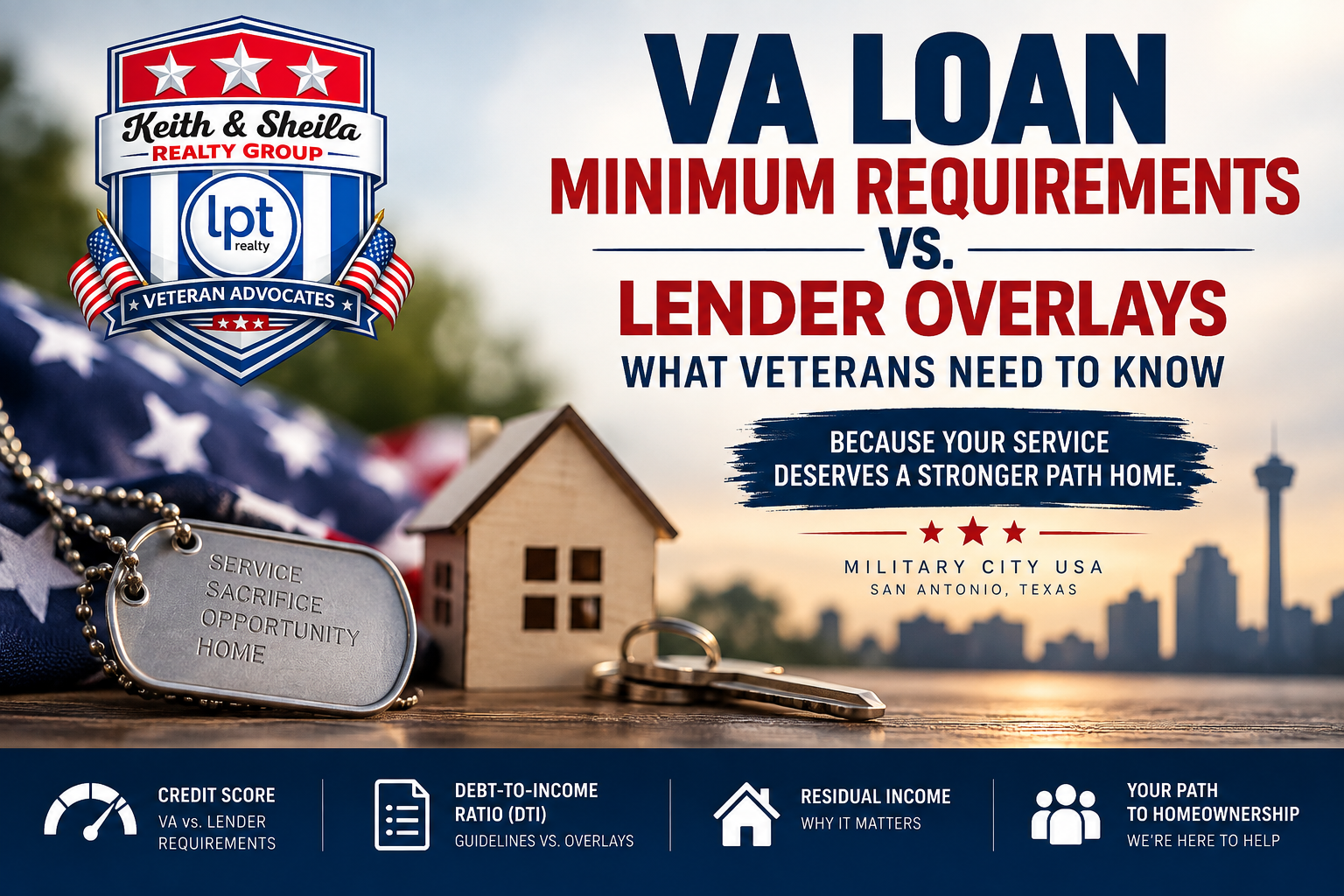
VA Loan Minimum Requirements vs. Lender Overlays: What Veterans Need to Know
If you've been told that you don't qualify for a VA home loan because of your credit score or debt-to-income ratio, there is something very important you should know:
The lender's requirements and the VA's requirements are not always the same.
This is one of the most common misunderstandings we see when helping Veterans and active-duty military families buy homes throughout Greater San Antonio and the JBSA area.
A lender may tell a Veteran, “You need a 620 credit score,” or “Your debt-to-income ratio is too high.”
But that doesn't necessarily mean the Department of Veterans Affairs requires those numbers.
In many cases, the borrower may be encountering what's known as a lender overlay.
Does the VA Have a Minimum Credit Score?
One of the biggest misconceptions about VA financing is that the VA requires borrowers to have a specific minimum credit score.
The Department of Veterans Affairs does not establish a minimum credit score for VA-backed home loans.
The VA requires lenders to evaluate the borrower's credit history, income, debts and overall ability to repay the mortgage.
However, an individual lender may establish its own minimum credit-score requirement.
For example, one lender might require:
- 620 minimum credit score
- 600 minimum credit score
- 580 minimum credit score
Those numbers may represent the lender's underwriting guidelines, rather than a VA-established minimum credit score.
That's an extremely important distinction for Veterans to understand.
What Is a VA Lender Overlay?
A lender overlay is an additional underwriting requirement established by a mortgage lender above or beyond the underlying VA loan guidelines.
The VA guarantees a portion of an eligible borrower's VA loan, but private mortgage companies, banks and credit unions generally provide the actual financing.
Because lenders are extending the money and accepting lending risk, they can establish additional underwriting standards.
Common lender overlays may involve:
- Minimum credit score
- Maximum debt-to-income ratio
- Bankruptcy history
- Foreclosure history
- Employment history
- Collections or charge-offs
- Cash reserves
- Manual underwriting
- Loan amount
- Property type
This means two VA-approved lenders can review the same Veteran's financial situation and potentially reach different conclusions.
What Is the Maximum Debt-to-Income Ratio for a VA Loan?
Debt-to-income ratio, commonly called DTI, is another area where Veterans frequently receive conflicting information.
You may have heard:
“VA loans have a maximum 41% debt-to-income ratio.”
That isn't quite accurate.
VA underwriting guidance treats 41% DTI as an important benchmark, but the VA Lender's Handbook specifically describes DTI as a guide and says it should not automatically trigger approval or rejection.
The VA also considers DTI secondary to another very important underwriting factor: residual income.
Therefore, a borrower having a DTI above 41% does not necessarily mean the borrower is automatically disqualified from obtaining a VA loan.
Residual Income Is Extremely Important With VA Loans
VA underwriting isn't based solely on a credit score or DTI percentage.
One of the VA loan program's important underwriting tools is residual income.
Residual income is essentially the money a household has remaining each month after major monthly obligations and housing-related expenses are considered.
VA residual-income guidelines take several factors into account, including:
- Family size
- Geographic region
- Loan amount
Texas falls within the VA's South region for residual-income calculations.
A borrower with strong residual income may present a stronger overall loan file, even when the debt-to-income ratio exceeds 41%.
That's one reason looking at DTI alone doesn't tell the entire story.
Why One VA Lender May Say No While Another Says Yes
Consider a hypothetical Veteran with:
- Credit score: 598
- Debt-to-income ratio: 46%
- Stable employment: Yes
- Strong residual income: Yes
- VA eligibility: Yes
Suppose Lender A requires a minimum 620 credit score.
That lender declines the loan.
The Veteran may understandably conclude:
“I don't qualify for a VA loan.”
But that may not actually be what happened.
The Veteran may simply not meet that particular lender's overlay.
Another VA-approved lender may have different underwriting standards and may be willing to evaluate the complete loan file.
This does not mean every borrower with a lower credit score or high DTI will automatically qualify. Credit history, income, debts, residual income and the entire financial picture still matter.
It does mean something very important:
A denial from one lender does not automatically mean you are ineligible for VA financing.
VA Eligibility Is Not the Same as VA Loan Approval
Your Certificate of Eligibility (COE) confirms that you meet the military-service eligibility requirements to use the VA home loan benefit.
A COE does not guarantee mortgage approval.
The lender must still determine whether you meet the applicable credit, income, debt and underwriting requirements.
VA eligibility: You have earned access to the VA home loan benefit.
Loan approval: You financially qualify for the specific mortgage.
These are two different things.
Don't Give Up After One VA Loan Denial
We've worked with military and Veteran families who believed they could not use their VA home loan benefit because someone previously told them they didn't qualify.
Sometimes the borrower genuinely needs additional time to improve his or her financial situation before buying.
In other situations, the problem may simply be the underwriting guidelines or overlays of the particular lender they contacted.
If you've been turned down because of your:
- Credit score
- Debt-to-income ratio
- Previous bankruptcy
- Previous foreclosure
- Collections
- Employment situation
- Other underwriting issue
it may be worthwhile to have another experienced VA lender review your situation before assuming your VA home loan benefit isn't an option.
Work With a San Antonio Real Estate Team That Understands VA Buyers
San Antonio is Military City USA, and buying a home here with a VA loan involves much more than simply finding a property.
Veterans and active-duty buyers benefit from working with professionals who understand important VA topics, including:
- Certificate of Eligibility (COE)
- VA entitlement
- VA appraisals
- Minimum Property Requirements (MPRs)
- VA Tidewater
- Reconsideration of Value (ROV)
- Residual income
- VA loan assumptions
- VA lender overlays
Keith & Sheila Realty Group has helped hundreds of military and Veteran families throughout Greater San Antonio, including families relocating to and from JBSA-Randolph, JBSA-Lackland and Fort Sam Houston.
Keith is also a U.S. Army Veteran and former Texas Professional Home Inspector, bringing an additional perspective to the VA home-buying process.
Frequently Asked Questions About VA Loan Requirements
Does the VA require a 620 credit score?
No. The Department of Veterans Affairs does not establish a minimum credit score for VA-backed home loans. Individual lenders may establish their own minimum credit-score requirements.
Can I get a VA loan with a credit score below 620?
Potentially. Because the VA itself does not establish a minimum credit score, some lenders may consider borrowers below 620. Approval depends on the lender's underwriting requirements and the borrower's complete financial profile.
Is 41% the maximum DTI for a VA loan?
No. The VA uses 41% as an important underwriting benchmark, but a DTI above 41% does not automatically require denial. Residual income and other compensating factors may be considered.
What is a VA lender overlay?
A lender overlay is an additional underwriting requirement established by an individual lender beyond the underlying VA loan guidelines. Minimum credit scores and additional DTI limitations are common examples.
Can another lender approve me after a VA loan denial?
Possibly. Different VA lenders can have different underwriting requirements and overlays. A denial from one lender does not automatically mean every VA-approved lender will decline the loan.
Does having a VA Certificate of Eligibility guarantee approval?
No. A COE establishes eligibility for the VA home loan benefit based on qualifying service. The borrower must still satisfy applicable VA and lender requirements for credit, income and the ability to repay the mortgage.
Have You Been Told You Don't Qualify for a VA Loan?
Don't assume one lender's decision means you've lost the opportunity to use your VA home loan benefit. Understanding the difference between VA guidelines and lender overlays can make a significant difference.
Schedule a Consultation Learn About VA Loan BenefitsMore Resources for San Antonio Veterans and Military Home Buyers
This article is provided for educational purposes only and is not a commitment to lend, mortgage approval, legal advice or financial advice. VA requirements and individual lender underwriting guidelines may change. Consult a qualified VA-approved mortgage lender regarding your individual financial situation.
Categories
Recent Posts







"Words cannot express our gratitude and thankfulness that Keith provided us when buying our home. Being a military family and not being able to physically be there is beyond challenging buying a house unseen. He made this whole process so pleasant and easy, always easing our minds because he had our complete best interests in his hands. He took the time to send videos, pictures, and did several walk-through of the home to make us feel like we were there. You can easily tell Keith has years of experience , always answering questions and helping us every step of the way! He was extremely helpful in guiding us through the process of buying our home, and making sure that everything was taken care of promptly and correctly. He has been nothing but extremely responsive and excellent since the first phone call! Keith is incredibly knowledgeable, a go-getter, and super professional. We truly sat in passenger seat and let Keith do the driving. He went above and beyond to find the perfect home for us. There's not another realtor out there that could've provided us with the ease and comfort knowing we were making all the right decisions! Keith and Sheila have our highest recommendation, and we wouldn’t ever want to work with any other agent. We will refer our friends and family to Keith and Sheila Realty again and again!" Nicole Olson - 2024