

When You Need a Pressure Compensated Drip System for Your Foundation
When Do You Need a Pressure Compensated Drip System for Your Foundation?
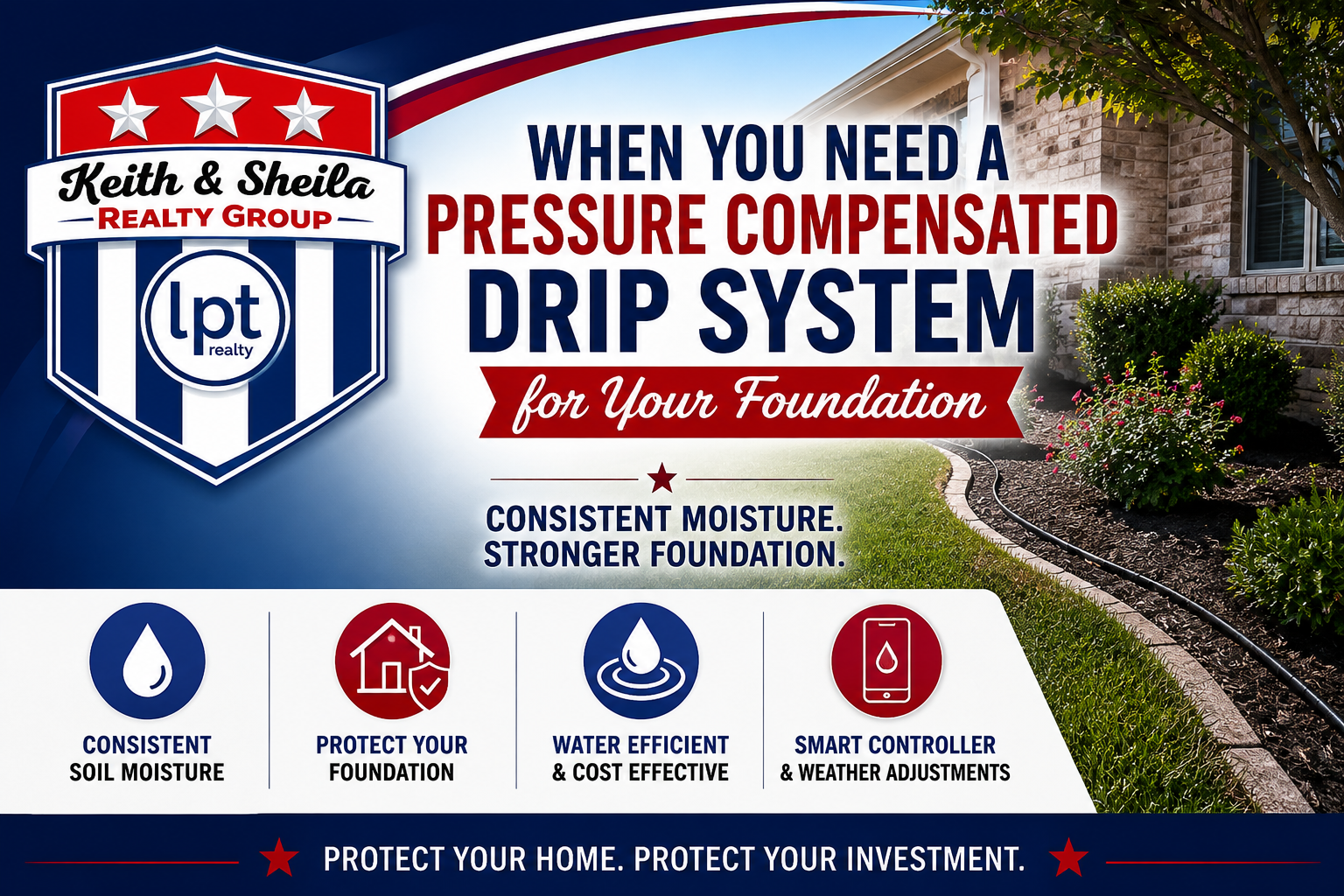
Many homes in Central Texas are built on expansive clay soils that expand when wet and shrink when dry. These constant moisture changes can cause soil movement beneath a home's foundation, leading to cracks, sticking doors and windows, uneven floors, and other structural concerns.
One of the most effective ways to help maintain consistent soil moisture around your foundation is by installing a pressure compensated drip irrigation system. Unlike traditional sprinkler heads, these systems deliver water slowly and evenly exactly where it's needed.
Why Soil Moisture Matters
Expansive clay soils can change volume dramatically depending on moisture content. When one side of the foundation becomes significantly drier than another, differential movement can occur. This uneven movement may eventually result in:
- Interior drywall cracks
- Exterior brick cracks
- Doors and windows sticking
- Uneven or sloping floors
- Cabinets separating from walls
- Gaps around windows and doors
The goal is not to keep the soil wet—it is to maintain consistent moisture around the entire perimeter of your home.
When Should You Consider Installing a Drip Foundation Watering System?
A pressure compensated drip system is often recommended if:
- Your sprinkler system does not evenly water around the entire foundation.
- Your home has landscape beds that block sprinkler coverage.
- You frequently experience prolonged summer droughts.
- Large trees are removing moisture from the soil near your home.
- Your home has experienced minor foundation movement in the past.
- You want a more water-efficient solution than spray irrigation.
- Your irrigation system has an available valve for a dedicated foundation zone.
Why Choose Pressure Compensated Drip Tubing?
Unlike standard drip tubing, pressure compensated emitters deliver nearly the same amount of water regardless of slight elevation changes or tubing length. This provides much more uniform watering around your home's perimeter.
Benefits include:
- Delivers water evenly regardless of slight elevation changes.
- Applies water slowly so it soaks into the soil instead of running off.
- Maintains more consistent soil moisture around the foundation.
- Uses significantly less water than traditional sprinklers.
- Reduces evaporation and runoff.
- Helps improve watering efficiency during drought restrictions.
Recommended Installation for Central Texas Homes
For most homes in the San Antonio and Central Texas area, consider the following setup:
- Tubing: ½-inch pressure compensated dripline
- Emitter Spacing: 12-inch or 18-inch spacing
- Flow Rate: 0.6 GPH or 0.9 GPH emitters
- Distance from Foundation: 12–18 inches from the slab edge
- Placement: Continuous loop around the home's perimeter
- Depth: Surface mounted beneath mulch or buried 1–2 inches
Do not install the tubing directly against the foundation.
Recommended Watering Schedule
Every property is different. Soil type, tree roots, rainfall, temperature, and landscaping all affect watering requirements.
During typical hot Texas summers, a general starting point is:
- Water 2–4 times each week.
- Run each cycle for approximately 30–90 minutes.
- Adjust schedules after rainfall.
- Reduce watering significantly during wet periods.
The objective is to maintain slightly moist soil—never muddy or saturated.
Add a Smart Irrigation Controller
Installing a Wi-Fi enabled irrigation controller can significantly improve efficiency by automatically adjusting watering based on weather conditions.
Benefits include:
- Automatically skips watering after rainfall.
- Seasonal runtime adjustments.
- Remote control from your smartphone.
- Lower water bills.
- Healthier landscape and foundation protection.
Additional Foundation Protection Tips
Do
- Maintain uniform soil moisture around the home's perimeter.
- Keep gutters clean.
- Extend downspouts at least 5–10 feet away from the foundation.
- Repair plumbing leaks promptly.
- Use mulch to reduce soil evaporation.
Don't
- Overwater one side of the house.
- Allow standing water against the slab.
- Run sprinklers that spray directly onto the foundation.
- Ignore mature trees that remove significant soil moisture.
Recommended Products
Several pressure compensated dripline products have earned excellent reputations among irrigation professionals:
- Rain Bird XFS Pressure Compensating Dripline
- Netafim Techline CV
- Hunter HDL Pressure Compensating Dripline
- Toro DL2000 Pressure Compensating Dripline
Our Recommendation for San Antonio Area Homes
Based on the expansive clay soils found throughout much of the Greater San Antonio area, we recommend:
- Rain Bird XFS 0.6 GPH pressure compensated dripline
- 12-inch emitter spacing
- Install approximately 15 inches from the slab
- Cover with 2–3 inches of hardwood mulch
- Operate with a dedicated foundation watering zone
- Pair with a Rain Bird ESP-TM2, Hunter Hydrawise, or Rachio Smart Controller
Professional Insight
Before becoming a REALTOR®, Keith Campbell spent years as a licensed Texas Irrigator, General Contractor, and Texas Professional Home Inspector, completing more than 4,000 home inspections. That experience has shown firsthand how maintaining consistent soil moisture can help reduce foundation movement caused by Texas' expansive clay soils. While no irrigation system can guarantee prevention of foundation issues, proper moisture management is an important part of protecting your home's long-term structural health.
Final Thoughts
A pressure compensated drip irrigation system is not necessary for every home. However, if your existing sprinkler system cannot provide consistent moisture around your foundation—or if your property is prone to soil drying due to trees, landscape beds, or prolonged drought—it can be one of the best investments you make to help protect your home's foundation.
Foundation Watering Resources
Learn how proper irrigation can help maintain consistent soil moisture and protect your home's foundation.
Helpful Resources
Learn more with these helpful home buying, selling, and homeowner resources.
Categories
Recent Posts










"Words cannot express our gratitude and thankfulness that Keith provided us when buying our home. Being a military family and not being able to physically be there is beyond challenging buying a house unseen. He made this whole process so pleasant and easy, always easing our minds because he had our complete best interests in his hands. He took the time to send videos, pictures, and did several walk-through of the home to make us feel like we were there. You can easily tell Keith has years of experience , always answering questions and helping us every step of the way! He was extremely helpful in guiding us through the process of buying our home, and making sure that everything was taken care of promptly and correctly. He has been nothing but extremely responsive and excellent since the first phone call! Keith is incredibly knowledgeable, a go-getter, and super professional. We truly sat in passenger seat and let Keith do the driving. He went above and beyond to find the perfect home for us. There's not another realtor out there that could've provided us with the ease and comfort knowing we were making all the right decisions! Keith and Sheila have our highest recommendation, and we wouldn’t ever want to work with any other agent. We will refer our friends and family to Keith and Sheila Realty again and again!" Nicole Olson - 2024